 One Turn
Space · October 31, 2026
Mars right now: closer every night
Earth is catching up with Mars again. Where the red planet is, why its distance swings by hundreds of millions of kilometers, and what the rover there photographed today.
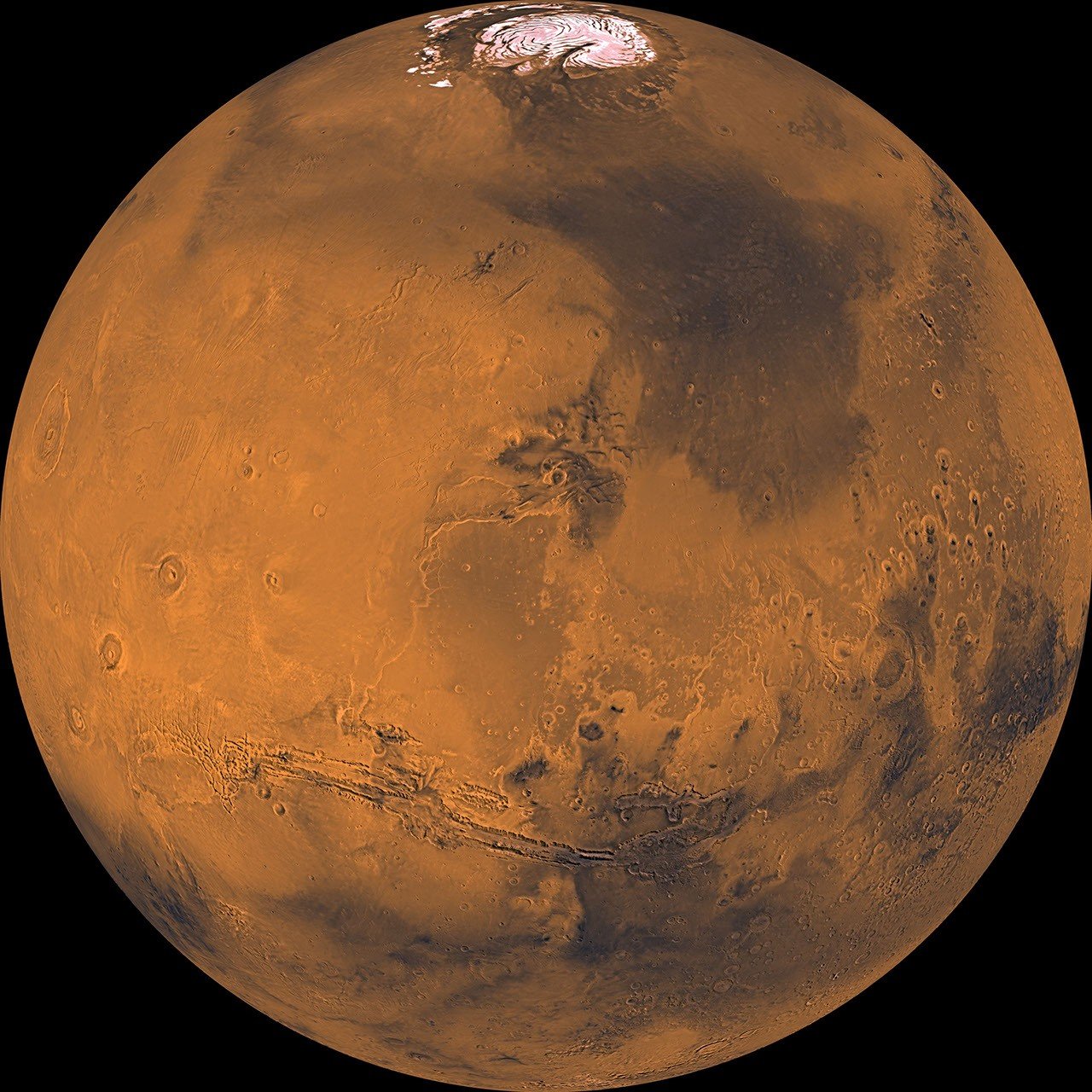
On One Turn you can fly from the globe to Mars and land beside the Perseverance rover, where its newest pictures are waiting. This is what you are looking at, and why the trip is getting shorter.
Two runners on different tracks
Earth and Mars both circle the Sun, but Earth is on the inside track and moves faster. Earth takes 365 days to go around. Mars takes 687. So Earth laps Mars about every 26 months.
When Earth passes Mars, the two planets are on the same side of the Sun and as close as they get: around 55 to 100 million kilometers (35 to 60 million miles), depending on where in its stretched orbit Mars happens to be. That moment is called opposition, because Mars is then opposite the Sun in our sky. It rises at sunset, shines all night, and is at its biggest and brightest.
Thirteen months later the two planets are on opposite sides of the Sun, up to 400 million kilometers apart, and Mars is a faint dot lost in the glare.
Where we are in the cycle
The last opposition was in January 2025. The next is on 19 February 2027. So right now, in late 2026, Earth is gaining on Mars from behind. Every night the distance shrinks a little, Mars rises a little earlier, and it gets a little brighter.
Look east late in the evening. Mars is the steady orange-red point that does not twinkle. Stars twinkle because they are points of light; planets are tiny discs, and the air steadies them. By the new year it will be unmistakable, and by February 2027 it will outshine every star in the sky.
How far is far
Distance on this scale is easier to feel as time. Light, and radio, takes between 3 and 22 minutes to cross from Earth to Mars, depending on the moment in the cycle. Engineers driving a rover cannot steer it live. They send a day's instructions, wait, and see what happened.
A spacecraft takes about seven months to make the trip with today's rockets, and only when the planets are lined up for it. Launch windows open for a few weeks every 26 months, just before opposition. Miss one and you wait two years.
What the rovers are doing
Two NASA rovers are working on Mars. Curiosity landed in Gale crater in 2012 and is still climbing the mountain at its center, reading the rock layers like pages. Perseverance landed in Jezero crater in February 2021. Jezero was a lake three and a half billion years ago, with a river delta that is still visible from orbit, and the rover has been drilling and sealing samples of its rock for a future mission to bring home.
Perseverance sends its raw pictures back within hours, and NASA publishes them straight away in the public domain. One Turn fetches the newest from its landscape cameras every hour. They are not processed or colored for effect: they are what the rover saw when it last looked up.
See it yourself
Open the Space tab and choose Mars. The trip arrives above Jezero crater, with the Today on Mars card showing the latest pictures and a link to each one on NASA's site. Then come back to Earth and look east. It is the same place.
Written by One Turn for One Turn. Unlike the daily summaries, articles are written by a person.